Figures

On this page you can find all figures and code to produce the figures of the manuscript.

Introduction

Figure 1

Code
# %% Imports etc.
# Default packages
import os, sys, pickle
import numpy as np
import matplotlib.pyplot as plt
plt.close('all')

# Paths
cwd = os.getcwd()
baseDir = os.path.join(cwd, '..')
dataDir = os.path.join(baseDir, 'data')
funcDir = os.path.join(baseDir, 'analysis', 'functions')
sys.path.append(funcDir)

# Custom imports ---
import cust_fig, hillmodel, make_data

# %% Load muscle parameters
mus = 'GMs1'
parFile = os.path.join(dataDir, mus, 'parameters', f'{mus}_OR.pkl')
muspar = pickle.load(open(parFile, 'rb'))
muspar['fmax'] *= 1.1  # adjust for figure scaling

musparV2 = muspar.copy()
musparV2.update({
    'lce_opt': muspar['lce_opt'] - 2.4e-3,
    'lsee0'  : muspar['lsee0']  + 1.2e-3,
    'ksee'   : muspar['ksee'] / 2,
})

# %% Figure setup
cust_fig.style(plt, fontname='MinionPro', fontsize=11)

fig = plt.figure(figsize=(15.92/2.54/3 +50/600, 7.34/2.54), constrained_layout=True)
gs = fig.add_gridspec(2, 1)
axs = np.array([[fig.add_subplot(gs[i, j]) for j in range(gs.ncols)] for i in range(gs.nrows)])
    
# %% Panel A: Force–Length relationship
lmtc = np.linspace(35.5, 44.5) * 1e-3
fsee    = hillmodel.ForceEQ(lmtc, 1, muspar)[0]
fseeV2  = hillmodel.ForceEQ(lmtc, 1, musparV2)[0]

ax = axs[0,0]
ax.plot(lmtc * 1000, fsee, 'k')
ax.plot(lmtc * 1000, fseeV2, 'r')
ax.set_xlabel(r"$L_{MTC}$ [mm]")
ax.set_ylabel("$F_{SEE}$ [N]")
ax.set_xlim(35.5, 44.5)
ax.set_ylim(0, 15)
ax.set_xticks([36, 38, 40, 42, 44], minor=False)
ax.set_xticks([37, 39, 41, 43], minor=True)
ax.set_yticks([0, 4, 8, 12], minor=False)
ax.set_yticks([2, 6, 10, 14], minor=True)

# %% Panel B: Fsee(t) during SSC
cf, fs, amp = 2, 2000, 2.5e-3
time = np.arange(0, 1/cf, 1/fs)
tStim = np.array([0.0, 1/(4*cf)])
stim = make_data.make_stim(time, *tStim)
solmat = {'time': time, 'lmtc': amp*np.cos(2*np.pi*time*cf)
          + muspar['lce_opt'] + muspar['lsee0']
          + (muspar['fmax']/muspar['ksee'])**0.5, 'tStim': tStim}

def simulate_force(params):
    gamma0 = params['gamma_0']
    lcerel0 = hillmodel.ForceEQ(solmat['lmtc'][0], gamma0, params)[1]
    return hillmodel.SolveSimuMTC(gamma0, lcerel0, params, solmat)[1][9]

ax = axs[1,0]
ax.plot(time, simulate_force(muspar), 'k')
ax.plot(time, simulate_force(musparV2), 'r')
ax.set_xlabel(r"Time [s]")
ax.set_ylabel(r"$F_{SEE}$ [N]")
ax.set_xlim(0, 1/cf)
ax.set_ylim(0, 9.5)
ax.set_xticks([0, 0.2, 0.4])
ax.set_xticks([0.1, 0.3, 0.5], minor=True)
ax.set_yticks([0, 2, 4, 6, 8])
ax.set_yticks([1, 3, 5, 7, 9], minor=True)

cust_fig.add_labels(fig, axs.flatten(), ['A', 'B'])
fig.align_labels()

# %% Save and display
plt.show()
fig.savefig('i_effect_ksee.pdf', bbox_inches='tight', pad_inches=0)
fig.savefig('i_effect_ksee.svg', bbox_inches='tight', pad_inches=0)

# %% Checks
if check_size == True or check_size == 'True':
    cust_fig.report_axes_size(fig,axs.flatten())
    cust_fig.report_fig_size("i_effect_ksee.pdf") 
    cust_fig.report_fig_size("i_effect_ksee.svg") 
Figure 1: Effect of a 2.5-fold difference in SEE stiffness on simulated mechanical behaviour. This example shows that some contractions may lead to similar mechanical behaviour across distinct parameter sets, others may differ substantially.

Methods

Figure 2

Code
# %% Imports etc.
import sys, os, pickle
import numpy as np
import pandas as pd
import matplotlib.pyplot as plt
from scipy.integrate import solve_ivp
plt.close('all')

# Paths
cwd = os.getcwd()
baseDir = os.path.join(cwd,'..')
dataDir = os.path.join(baseDir,'data')
funcDir = os.path.join(baseDir,'analysis','functions')
sys.path.append(funcDir)

# Custom imports
import cust_fig, hillmodel

# %% Load muscle parameters
mus = 'GMs1'
parFile = os.path.join(dataDir,mus,'parameters',mus+'_OR.pkl')
muspar = pickle.load(open(parFile, 'rb'))

# %% Figure setup
cust_fig.style(plt, fontname='MinionPro', fontsize=11, grid=True)

fig = plt.figure(figsize=(15.92/2.54+50/600, (15.92/3*2-0.5)/2.54), constrained_layout=True) # 2:1 ratio (3761px x 1880px)
gs = fig.add_gridspec(4, 2,height_ratios=[10/1.5, 10, 1/2.9, 10], hspace=0)
axs = np.array([[fig.add_subplot(gs[i, j]) for j in range(gs.ncols)] for i in range(gs.nrows)])
axs[0,0].remove(); axs[0,1].remove(); 
axs[0,0] = fig.add_subplot(gs[0, :])
axs[2,0].remove(); 

# %% Panel 0: Schematic MTC model
data = pd.read_csv("m_mtc_data.txt", sep=',')
x = data.to_numpy()[:,0]
y = data.to_numpy()[:,1]
n = 35 # endpoint CE

ax = axs[0,0]
ax.set_axis_off()
ax.plot(x,y,'k',lw=1)
ax.plot(x[n],y[n],'k',marker='.')
ax.plot(np.array([0,x[0]]),np.array([0,y[0]]),'k')
ax.annotate('', xy=(0,-10), xycoords='data', xytext=(x[n], -10), arrowprops=dict(arrowstyle="<->", lw=0.5, shrinkA = 0, shrinkB = 0))
ax.text(x[n]/2,-16, "$L_{CE} = L_{PEE}$", color="k",ha="center", va = 'bottom') # else part of xlabel is cropped..
ax.annotate('', xy=(x[n],-10), xycoords='data', xytext=(x[-1], -10), arrowprops=dict(arrowstyle="<->", lw=0.5, shrinkA = 0, shrinkB = 0))
ax.text((x[-1]-x[n])/2+x[n],-16, "$L_{SEE}$", color="k",ha="center", va = 'bottom') # else part of xlabel is cropped..
ax.plot([0,0],[-16,-16], alpha=0)
ax.axis('equal')
ax.autoscale(enable=True, axis='x', tight=True)

# %% Panel A: q(gamma)
ax = axs[1,0]

n = 101
gamma = np.linspace(muspar['gamma_0'],1,n)
qlijn = -gamma*2.5+1.5;
for iL,lcerel in enumerate([1.45,1.15,0.85,0.55]):
    if iL%2 == 0:
        clr = "gray"
    else:
        clr = "k" # gray if we want to switch..
    q = hillmodel.ActState(gamma,np.repeat(lcerel,n),muspar)[0]
    l, = ax.plot(gamma,q,color=clr)
    idx = np.argmin(np.abs(q-qlijn))
    angle = np.rad2deg(np.arctan2(np.gradient(q,gamma)[idx], 1))
    ax.text(gamma[idx], q[idx], '{:.2f}'.format(lcerel), ha='center', va='center', fontsize = 7, color = clr,
                 transform_rotates_text=True, rotation=angle, bbox=dict(ec='1', fc='1', pad=0.1))
   
ax.annotate('$L_{CE}^{rel}$', xy=(gamma[idx]+0.01, q[idx]-0.01), xycoords='data', xytext=(42, -19), 
                textcoords='offset points', arrowprops=dict(arrowstyle="->",lw=0.5, connectionstyle="arc3,rad=-.4"))
ax.set_xlabel(r"$\gamma$ [ ]")
ax.set_ylabel(r"$q$ [ ]")
ax.set_xlim(0,1)
ax.set_ylim(0,1.125)
ax.set_xticks([0.0,0.25,0.5,0.75,1.0])
ax.set_xticklabels(["0.0","","0.5","","1.0"])
ax.set_yticks([0.0,0.25,0.5,0.75,1.0])
ax.set_yticklabels(["0.0","","0.5","","1.0"])

# %% Panel B: fisomrel(lcerel,q) ---
ax = axs[1,1]
lcerel = np.linspace(0,2,n)
fisomrel = hillmodel.ForceLength(lcerel,muspar)[0]

idx = np.argmin(np.abs(lcerel-1))
for iGam,gamma in enumerate([0.10,0.20,0.30,1.00]):
    if iGam%2 == 0:
        clr = "gray"
    else:
        clr = "k" # gray if we want to switch..
    q = hillmodel.ActState(gamma,lcerel,muspar)[0]
    ax.plot(lcerel,q*fisomrel,color=clr)
    angle = np.rad2deg(np.arctan2(np.gradient(q,lcerel)[idx], 1))
    ax.text(lcerel[idx],q[idx], '{:.2f}'.format(gamma), ha='center', va='center', fontsize = 7, color=clr,
                  transform_rotates_text=True, rotation=angle, bbox=dict(ec='1', fc='1', pad=0.1))

ax.annotate(r'$\gamma$', xy=(lcerel[idx],q[idx]+0.07), xycoords='data', xytext=(70, -20), 
                textcoords='offset points', arrowprops=dict(arrowstyle="->", lw=0.5, connectionstyle="arc3,rad=.35"), annotation_clip=True)
ax.set_xlabel(r"$L_{CE}^{rel}$ [ ]")
ax.set_xticks([muspar['w'],1,1+muspar['w']])
ax.set_xticklabels(["1-$w$","1.0","1+$w$"])
ax.set_xlim(0.3,1.7)

ax.set_ylabel(r"$q \cdot F_{CE}^{isom,rel}$ [ ]")
ax.set_yticks([0.0,0.25,0.5,0.75,1.0])
ax.set_yticklabels(["0.0","","0.5","","1.0"])
ax.set_ylim(0,1.125)

# %% Panel C: fcerel(vcerel)
ax = axs[3,0]

lcerel = np.repeat(1,n)
fisomrel = hillmodel.ForceLength(lcerel,muspar)
# vcerel = np.linspace(-muspar['brel']/muspar['arel'],muspar['brel']/muspar['arel'],n)
# fcerel = np.linspace(0,1.5,n)*idx
fce = np.linspace(0,1.5,n)*muspar['fmax']

vce = np.linspace(-muspar['b']/muspar['a'],muspar['b']/muspar['a'],n)*muspar['fmax']
qs = [0.05,0.25,0.50,0.75,1.00]
idx = n-20
for iFV,q in enumerate(qs):
    if iFV%2 == 0:
        clr = "k"
    else:
        clr = "gray" # gray if we want to switch..
    fce,fcerel = hillmodel.Vce2Fce(vce,q,1,muspar)[0:2]
    ax.plot(vce,fcerel,color=clr)
    ax.text(vce[idx],fcerel[idx], '{:.2f}'.format(q), ha='center', va='center', fontsize = 7, color=clr,
                  transform_rotates_text=True, rotation=angle, bbox=dict(ec='1', fc='1', pad=0.1))

ax.annotate('$q$', xy=(vce[idx],fcerel[idx]+0.1), xycoords='data', xytext=(-80, -18.5), 
                textcoords='offset points', arrowprops=dict(arrowstyle="->",lw=0.5, connectionstyle="arc3,rad=-.3"),annotation_clip=False)

ax.set_xlabel(r'$v_{CE}$ [mm/s]')
ax.set_xticks([-muspar['b']*muspar['fmax']/muspar['a'],-0.5*muspar['b']*muspar['fmax']/muspar['a'],0,0.5*muspar['b']*muspar['fmax']/muspar['a'],muspar['b']*muspar['fmax']/muspar['a']])
ax.set_xticklabels([r"$\frac{-b \cdot F_{CE}^{max}}{a}$","","0","",r"$\frac{b \cdot F_{CE}^{max}}{a}$"])
ax.set_xticklabels([r"$-b \cdot F_{CE}^{max}/a$","","0","",r"$b \cdot F_{CE}^{max}/a$"])
ax.set_xlim(-muspar['b']*muspar['fmax']/muspar['a'],muspar['b']*muspar['fmax']/muspar['a'])

ax.set_ylabel(r"$F_{CE}^{rel}$ [ ]")
ax.set_yticks([0.0,0.25,0.5,0.75,1.0,1.25,1.5])
ax.set_yticklabels(["0.0","","0.5","","1.0",'','1.5'])
ax.set_ylim(0,1.75)

# %% Panel D: q(t)
ax = axs[3,1]
def Solve(t,gamma,parms,tStim):  
    stim = ((t>=tStim[0]) & (t<tStim[1]))*1
    
    gamma_0 = parms['gamma_0'];
    gammad = (stim>=gamma)*((stim*(1-gamma_0)-gamma + gamma_0)/parms['tact']) + (stim<gamma)*((stim*(1-gamma_0)-gamma + gamma_0)/parms['tdeact']);
    return gammad, stim

state0 = [muspar['gamma_0']]
n = 81
tspan = [0, 0.5]
tStim = [0.1,0.2]

fun = lambda t, x: Solve(t,x,muspar,tStim)[0]
sol = solve_ivp(fun,tspan,state0,method='RK45',max_step=1e-3,rtol=1e-4,atol=1e-8)
stim = Solve(sol.t,sol.y,muspar,tStim)[1]
time = sol.t; gamma = sol.y[0];

n = len(gamma)
# q = ActState(gamma,1,muspar)[0]

for iL,lcerel in enumerate([1.4,1.0,0.6]):
    if iL%2 == 0:
        clr = "k"
    else:
        clr = "gray" # gray if we want to switch..
    q = hillmodel.ActState(gamma,lcerel,muspar)[0]
    ax.plot(time,q,color=clr)
    
    idx = np.argmin(np.abs(q[200:]-0.5))+200
    angle = np.rad2deg(np.arctan2(np.gradient(q,time)[idx], 1))
    ax.text(time[idx],q[idx], '{:.2f}'.format(lcerel), ha='center', va='center', fontsize = 7, color=clr,
                  transform_rotates_text=True, rotation=angle, bbox=dict(ec='1', fc='1', pad=0.1))

ax.annotate('$L_{CE}^{rel}$', xy=(time[idx]-0.005, q[idx]), xycoords='data', xytext=(-42, -19), 
                textcoords='offset points', arrowprops=dict(arrowstyle="->",lw=0.5, connectionstyle="arc3,rad=-.3"))

ax.set_xlabel(r"Time [s]")
ax.set_ylabel(r"$q$ [ ]")

ax.set_xlim(0,0.325)
ax.set_ylim(0,1.125)
ax.set_xticks([0,0.05,0.10,0.15,0.20,0.25,0.3]);
ax.set_xticklabels(["0","","0.1","","0.2",'','0.3'])
ax.set_yticks([0.0,0.25,0.5,0.75,1.0])
ax.set_yticklabels(["0.0","","0.5","","1.0"])

# %% STIM bar of Panel D
ax = axs[2,1]
import matplotlib.patches as patches
from matplotlib.path import Path
verts = [
   (tStim[0], 0.99),  # left, bottom
   (tStim[0], 1.01),  # left, top
   (tStim[1], 1.01),  # right, top
   (tStim[1], 0.99),  # right, bottom
]

codes = [
    Path.MOVETO,
    Path.LINETO,
    Path.LINETO,
    Path.LINETO,
]

path = Path(verts, codes)
patch = patches.PathPatch(path, facecolor='k', lw=0)
ax.add_patch(patch)
ax.spines['bottom'].set_visible(False)
ax.spines['left'].set_visible(False)
ax.set_xticks([]);
ax.set_yticks([]); 
ax.set_xlim(0,0.325)
ax.set_ylim(0.98,1.02)
ax.autoscale(enable=True, axis='y', tight=True)

cust_fig.add_labels(fig, axs.flatten(), ['','','A','B','','','C','D'])
axs[2,1].label = 'STIM bar'

# %% Save and display
plt.show()
fig.savefig("m_hill_model.svg", bbox_inches="tight", pad_inches=0)
fig.savefig("m_hill_model.pdf", bbox_inches="tight", pad_inches=0)

#%% Checks
if check_size == True or check_size == 'True':
    cust_fig.report_axes_size(fig,axs.flatten())
    cust_fig.report_fig_size("m_hill_model.svg")  
    cust_fig.report_fig_size("m_hill_model.pdf") 
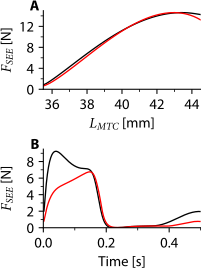
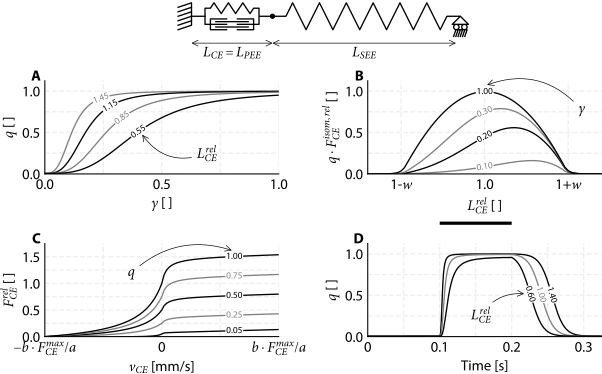
Figure 2: Aspects of the Hill-type MTC model used, illustrated at the top. \(L_{CE}\), \(L_{PEE}\) and \(L_{SEE}\) denote the CE, parallel elastic element (SEE) and serial elastic element (SEE) length. CE represents the contractile part of the muscle fibres, while PEE and SEE represent all elastic tissue in parallel or in series, respectively, with CE. In the Hill-type MTC model, CE force depends on active state (A), CE length (B) and CE velocity (C). The effect of CE stimulation on active state (\(q\)) is illustrated in D. A) The relationship between normalised free \(Ca^{2+}\) concentration between the myofilaments (\(\gamma\)) and \(q\). \(q\) also depends on relative CE length (\(L_{CE}^{rel}\)). B) The product of \(q\) and the normalised active CE force-length relationship for different values of \(\gamma\). C) The CE force-velocity relationship for different values of \(q\). D) \(q\) over time before, during and after CE stimulation for \(L_{CE}^{rel}=1\). CE stimulation is maximal during the period indicated by the black bar and ‘off’ elsewhere.

Figure 3

Code
# %% Imports
import glob, os, sys
import numpy as np
import pandas as pd
import matplotlib.pyplot as plt
import matplotlib.patches as patches
from matplotlib.path import Path
plt.close('all')

# Paths
cwd = os.getcwd()
baseDir = os.path.join(cwd,'..')
dataDir = os.path.join(baseDir,'data')
funcDir = os.path.join(baseDir,'analysis','functions')
sys.path.append(funcDir)

# Custom imports
import cust_fig, helpers, mp_estimator

# %% Load muscle parameters
mus = 'GMs1'
parFile = os.path.join(dataDir,mus,'parameters',mus)
dataDirMus = os.path.join(dataDir,mus,'dataExp','')

# %% Figure setup
cust_fig.style(plt, fontname='MinionPro', fontsize=11, grid=False)

fig = plt.figure(figsize=((15.92/2.54)+50/600, (15.92/3-0.32)/2.54), constrained_layout=True) # 3:1 ratio
gs = fig.add_gridspec(3,3,height_ratios=[1,1/6.0,4])
axs = np.array([[fig.add_subplot(gs[i, j]) for j in range(gs.ncols)] for i in range(gs.nrows)])

colorSet = plt.rcParams['axes.prop_cycle'].by_key()['color']
colorSet[0] = '#000000'

# %% QR exp
iFile = 5
files = sorted(glob.glob(dataDirMus+'QR/'+mus+r'*.csv'))
filepath = files[iFile]
data = pd.read_csv(filepath).T.to_numpy()
time, lmtc, stim, fsee = data[0:4]
_,tStimOn,tStimOff = helpers.get_stim(time,stim)

# Get selection of data
optsQR = {
    'dataDir':          dataDirMus+'QR',
    'iCols':            (0,1,3),
    'idxQRmin':         'auto',
    'idxQRpre':         'auto',
    'idxQRpst':         'auto',
    'nQRsamp':          'auto',
    'dispFig':          False,
    }
_,idxQRmin,idxQRpre,idxQRpst = mp_estimator.loaddata.qr(optsQR)

# Select interesting part of data
iOn = np.argmin(abs(time-tStimOn[0]+0.05))
iOff = np.argmin(abs(time-tStimOff[-1]-0.1))
iSel = slice(iOn,iOff)
time = time[iSel]-time[iSel][0]
lmtc = lmtc[iSel]
stim = stim[iSel]
fsee = fsee[iSel]
tStimOff = tStimOff[0]-tStimOn[0]+0.05
tStimOn = tStimOn[0]-tStimOn[0]+0.05
idxQRpre = int(np.mean(np.arange(idxQRpre[iFile][0]-iOn,idxQRpre[iFile][-1]-iOn)))
idxQRpst = int(np.mean(np.arange(idxQRpst[iFile][0]-iOn,idxQRpst[iFile][-1]-iOn)))
tQRpre = time[idxQRpre]
tQRpst = time[idxQRpst]
fQRpre = fsee[idxQRpre]
fQRpst = fsee[idxQRpst]
lQRpre = lmtc[idxQRpre]
lQRpst = lmtc[idxQRpst]

# Plot lmtc(t)
ax = axs[0,0]
ax.plot(time,lmtc,'k')
ax.set_ylim(lmtc.min()-1e-4,lmtc.max()+1e-4)
ax.set_axis_off()

# Plot stim(t)
ax = axs[1,0]
verts = [
   (tStimOn, 0.99),  # left, bottom
   (tStimOn, 1.01),  # left, top
   (tStimOff, 1.01),  # right, top
   (tStimOff, 0.99),  # right, bottom
]

codes = [
    Path.MOVETO,
    Path.LINETO,
    Path.LINETO,
    Path.LINETO,
]

path = Path(verts, codes)
patch = patches.PathPatch(path, facecolor='k', lw=0)
ax.add_patch(patch)
ax.set_ylim(0.98,1.02)
ax.set_axis_off()
ax.autoscale(enable=True, axis='y', tight=True)

# Plot fsee(t)
ax = axs[2,0]
ax.plot(time,fsee,'k')
ax.set_xticks([])
ax.set_ylim(0,np.max(fsee))
ax.set_yticks([])

# Mark time-stances of data selection
ax.plot(0.025,fsee[50],'.',color=colorSet[1],markersize=8)
ax.plot(tQRpre,fQRpre,'.',color=colorSet[0],markersize=8)
ax.plot(tQRpst,fQRpst,'.',color=colorSet[2],markersize=8)
ax.annotate(r'$F_{SEE}^{MIN,data}$', xy=(0.025+0.004,fsee[50]-0.4), xycoords='data', xytext=(0.12, -2), 
                textcoords='data', arrowprops=dict(arrowstyle="->", lw=0.5, connectionstyle="arc3,rad=-0.4"), color= colorSet[1])
ax.annotate(r'$F_{SEE}^{QR-,data}$', xy=(tQRpre-0.004,fQRpre-0.4), xycoords='data', xytext=(tQRpre-0.16, fQRpre-7), 
                textcoords='data', arrowprops=dict(arrowstyle="->", lw=0.5, connectionstyle="arc3,rad=0.4"), color=colorSet[0])
ax.annotate(r'$F_{SEE}^{QR+,data}$', xy=(tQRpst+0.004,fQRpst-0.4), xycoords='data', xytext=(tQRpst-0.02, fQRpst-7), 
                textcoords='data', arrowprops=dict(arrowstyle="->", lw=0.5, connectionstyle="arc3,rad=0.4"), color=colorSet[2])

# Axis limits
axs[0,0].set_xlim(0,time[-1])
axs[1,0].set_xlim(0,time[-1])
axs[2,0].set_xlim(0,time[-1])

# %% SR exp
iFile = 3
files = sorted(glob.glob(dataDirMus+'SR/'+mus+r'*.csv'))
filepath = files[iFile]
data = pd.read_csv(filepath).T.to_numpy()
time, lmtc, stim, fsee = data[0:4]
_,tStimOn,tStimOff = helpers.get_stim(time,stim)

dataDirMus = os.path.join(dataDir,mus,'dataExp','')
parFile = os.path.join(dataDir,mus,'Parameters',mus)

# Get selection of data
optsSR = {
    'dataDir':          dataDirMus+'QR',
    'iCols':            (0,1,3),
    'idxQRmin':         'auto',
    'idxQRpre':         'auto',
    'idxQRpst':         'auto',
    'nQRsamp':          'auto',
    'dispFig':          False,
    }
_,idxSRcon = mp_estimator.loaddata.sr(optsSR)

# Select interesting part of data
iOn = np.argmin(abs(time-tStimOn[0]+0.05))
iOff = np.argmin(abs(time-tStimOff[-1]-0.1))
iSel = slice(iOn,iOff)
time = time[iSel]-time[iSel][0]
lmtc = lmtc[iSel]
stim = stim[iSel]
fsee = fsee[iSel]
tStimOff = tStimOff[0]-tStimOn[0]+0.05
tStimOn = tStimOn[0]-tStimOn[0]+0.05
idxSRcon = int(np.mean(np.arange(idxSRcon[iFile][0]-iOn,idxSRcon[iFile][-1]-iOn)))
tSRcon = time[idxSRcon]
fSRcon = fsee[idxSRcon]
lSRcon = lmtc[idxSRcon]

# Plot lmtc(t)
ax = axs[0,1]
ax.plot(time,lmtc,'k')
ax.set_axis_off()

# Plot stim(t)
ax = axs[1,1]
verts = [
   (tStimOn, 0.99),  # left, bottom
   (tStimOn, 1.01),  # left, top
   (tStimOff, 1.01),  # right, top
   (tStimOff, 0.99),  # right, bottom
]

codes = [
    Path.MOVETO,
    Path.LINETO,
    Path.LINETO,
    Path.LINETO,
]

path = Path(verts, codes)
patch = patches.PathPatch(path, facecolor='k', lw=0)
ax.add_patch(patch)
ax.set_ylim(0.98,1.02)
ax.set_axis_off()
ax.autoscale(enable=True, axis='y', tight=True)

# Plot fsee(t)
ax = axs[2,1]
ax.plot(time,fsee,'k')
ax.set_xticks([])
ax.set_ylim(0,np.max(fsee))
ax.set_yticks([])

# Mark time-stances of data selection
ax.plot(tSRcon,fSRcon,'.',color=colorSet[0],markersize=8)
ax.annotate(r'$F_{SEE}^{SR,data}$', xy=(tSRcon-0.002,fSRcon-0.25), xycoords='data', xytext=(tSRcon-0.2,fSRcon-5), 
                textcoords='data', arrowprops=dict(arrowstyle="->", lw=0.5, connectionstyle="arc3,rad=.39"), color=colorSet[0])

# %% Isom exp
iFile = 6
files = sorted(glob.glob(dataDirMus+'ISOM/'+mus+r'*.csv'))
filepath = files[iFile]
data = pd.read_csv(filepath).T.to_numpy()
time, lmtc, stim, fsee = data[0:4]
_,tStimOn,tStimOff = helpers.get_stim(time,stim)

dataDirMus = os.path.join(dataDir,mus,'dataExp','')
parFile = os.path.join(dataDir,mus,'Parameters',mus)

# Get selection of data
optsISOM = {
    'dataDir':          dataDirMus+'ISOM',
    'iCols':            (0,1,3,2),
    'durStimOffset':    0.1,
    'dispFig':          False,
    }
_, idxSEL = mp_estimator.loaddata.isom(optsISOM)

# Select interesting part of data
iOn = np.argmin(abs(time-tStimOn[0]+0.05))
iOff = np.argmin(abs(time-tStimOff[-1]-0.1))
iSel = slice(iOn,iOff)
time = time[iSel]-time[iSel][0]
lmtc = lmtc[iSel]
stim = stim[iSel]
fsee = fsee[iSel]
tStimOff = tStimOff[0]-tStimOn[0]+0.05
tStimOn = tStimOn[0]-tStimOn[0]+0.05

# Plot lmtc(t)
ax = axs[0,2]
ax.plot(time,lmtc,'k')
ax.set_axis_off()

# Plot stim(t)
ax = axs[1,2]
verts = [
   (tStimOn, 0.99),  # left, bottom
   (tStimOn, 1.01),  # left, top
   (tStimOff, 1.01),  # right, top
   (tStimOff, 0.99),  # right, bottom
]

codes = [
    Path.MOVETO,
    Path.LINETO,
    Path.LINETO,
    Path.LINETO,
]

path = Path(verts, codes)
patch = patches.PathPatch(path, facecolor='k', lw=0)
ax.add_patch(patch)
ax.set_ylim(0.98,1.02)
ax.set_axis_off()
ax.autoscale(enable=True, axis='y', tight=True)
ax.set_xticks([])
ax.set_yticks([])

# Plot fsee(t)
ax = axs[2,2]
ax.plot(time,fsee,'k')
ax.set_xticks([])
ax.set_ylim(0,np.max(fsee))

# %% Labels etc.
# Xlim
axs[0,2].set_xlim(0,time[-1])
axs[1,2].set_xlim(0,time[-1])
axs[2,2].set_xlim(0,time[-1])

# Titles
axs[0,0].set_title('QR')
axs[0,1].set_title('SR')
axs[0,2].set_title('ISOM')

# Labels
axs[2,0].set_xlabel('Time')
axs[2,1].set_xlabel('Time')
axs[2,2].set_xlabel('Time')
axs[2,0].set_ylabel(r'$F_{SEE}$')

# Set y-range similar
axs[2,0].set_ylim(-4,14)
axs[2,1].set_ylim(-4,14)
axs[2,2].set_ylim(-4,14)

# SR
axs[0,1].set_xlim(0,0.5)
axs[1,1].set_xlim(0,0.5)
axs[2,1].set_xlim(0,0.5)
axs[2,1].set_xticks([])
axs[2,2].set_yticks([])

labels = ['A', 'B', 'C']
cust_fig.add_labels(fig,axs[2,:],labels)

# %%  Save and display
plt.show()        
fig.savefig('m_protocols.svg', bbox_inches="tight", pad_inches=0)
fig.savefig('m_protocols.pdf', bbox_inches="tight", pad_inches=0)

# %% Checks
if check_size == True or check_size == 'True':
    cust_fig.report_axes_size(fig,axs.flatten())
    cust_fig.report_fig_size("m_protocols.svg")
    cust_fig.report_fig_size("m_protocols.pdf")
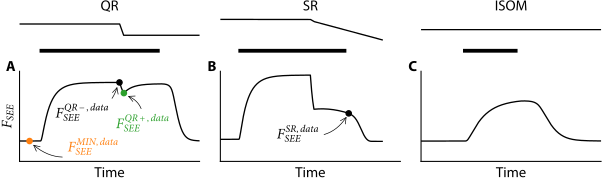
Figure 3: Example of simulated data of quick-release (A), step-ramp (B) and isometric (C) experiments.** Top: MTC length over time. Bottom: SEE force over time. CE stimulation is maximal during the period indicated by the black bar, and ‘off’ elsewhere. For each experiment, we obtained specific datapoints of SEE force and the corresponding MTC length, which were used to estimate contraction and excitation dynamics parameter values.

Figure 4

Code
# %% Imports etc.
import os, sys, pickle
import numpy as np
import matplotlib.pyplot as plt
from scipy import optimize
plt.close('all')

# Paths
cwd = os.getcwd()
baseDir = os.path.join(cwd,'..')
dataDir = os.path.join(baseDir,'data')
funcDir = os.path.join(baseDir,'analysis','functions')
sys.path.append(funcDir)

# Custom imports
import cust_fig, mp_estimator

# %% Load muscle parameters
mus = 'GMs1'
parFile = os.path.join(dataDir,mus,'parameters',mus+'_OR.pkl')
muspar = pickle.load(open(parFile, 'rb'))

# %% Figure setup
cust_fig.style(plt, fontname='MinionPro', fontsize=11, grid=True)

fig = plt.figure(figsize=((15.92/3*2)/2.54+50/600, (15.92/2-3.534)/2.54), constrained_layout=True) # 3:1 ratio
gs = fig.add_gridspec(1,2)
axs = np.array([[fig.add_subplot(gs[i, j]) for j in range(gs.ncols)] for i in range(gs.nrows)])

# Panel A: Fsee(Lsee) of one exp
ax = axs[0,0]
   
lseeBS = np.array([30])
lseeAS = np.array([29])
 
fseeBSdata = np.array([7])
fseeASdata = np.array([2])
        
lseeDeltaStep = lseeAS-lseeBS
kseeIndv = ((np.sqrt(fseeASdata) - np.sqrt(fseeBSdata))/(lseeDeltaStep))**2
ksee1 = np.mean(kseeIndv)

lseeoffset = (fseeBSdata/np.mean(kseeIndv))**(1/2)
seePar0 = np.insert(lseeoffset,0,np.mean(kseeIndv))
fun = lambda x: mp_estimator.objectives.cstfnc_see(x,lseeDeltaStep,fseeBSdata,fseeASdata,muspar)[0]
seeParA = optimize.fmin(fun,seePar0,maxfun=1e7,ftol=1e-6, disp=False)

fseeMdl = np.linspace(0,8,100)
lsee = (fseeMdl/seeParA[0])**(1/2)
l1,*_ = ax.plot(lsee,fseeMdl,color=[0,0,0],linestyle='-')
p1,*_ = ax.plot(seeParA[1],fseeBSdata,'k.',seeParA[1]+lseeDeltaStep,fseeASdata,'k.',markersize=8)

xs = seeParA[1]+lseeDeltaStep[0]
xs = xs/2.3
xe = seeParA[1]
xe = xe/2.3
xm = (xs+xe)/2

ax.annotate('', xy=(xs, 0.16), xycoords='axes fraction', xytext=(xe, 0.16),
            arrowprops=dict(arrowstyle="<->", lw=0.5, color='k'))
ax.annotate(r'$\Delta L_{SEE}^{QR}$', xy=(xm, 0.15), xycoords='axes fraction', ha="center", va="top")

ax.set_xlim(0,2.3)
ax.set_xticks([0,seeParA[1],seeParA[1]+lseeDeltaStep[0]])
ax.set_xticklabels([r'0','',r'$L_{SEE}^{offset}$'])
ax.set_xticks([])

ax.set_ylim(0,8)
ax.set_yticks([])
ax.set_ylabel('$F_{SEE}$')
ax.set_ylabel('')
ax.set_yticks([0,fseeBSdata[0],fseeASdata[0]])
ax.set_yticklabels(['0',r'$F_{SEE}^{QR-,data}$',r'$F_{SEE}^{QR+,data}$'])
ax.set_xticks([0,seeParA[1]])
ax.set_xticklabels([r'0',r'$c_{SEE}$'])

# %% Panel B: Fsee(Lsee) of two exp
ax = axs[0,1]

lseeBS = np.array([30, 29.5])
lseeAS = np.array([29, 29])
 
fseeBSdata = np.array([7, 4])
fseeASdata = np.array([2, 1])
        
lseeDeltaStep = lseeAS-lseeBS
kseeIndv = ((np.sqrt(fseeASdata) - np.sqrt(fseeBSdata))/(lseeDeltaStep))**2
ksee1 = np.mean(kseeIndv)

lseeoffset = (fseeBSdata/np.mean(kseeIndv))**(1/2)
seePar0 = np.insert(lseeoffset,0,np.mean(kseeIndv))
fun = lambda x: mp_estimator.objectives.cstfnc_see(x,lseeDeltaStep,fseeBSdata,fseeASdata,muspar)[0]
seeParB = optimize.fmin(fun,seePar0,maxfun=1e7,ftol=1e-6, disp=False)
seeParB[0] = seeParB[0]*1.3
seeParB[1] = seeParB[1]-0.2
seeParB[2] = seeParB[2]-0.25
fseeBSdata = np.array([7, 4])
fseeASdata = np.array([2, 0.5])

clr = [0.5,0.5,0.5]
clr2 = [0,0,0]
fseeMdl = np.linspace(0,8,100)
lsee = (fseeMdl/seeParB[0])**(1/2)

x = np.array([seeParB[1],seeParB[1]])
y = np.array([fseeBSdata[0],seeParB[1]**2*seeParB[0]])
ax.plot(x,y,color=clr2,linestyle='-')
x = np.array([seeParB[1]+lseeDeltaStep[0],seeParB[1]+lseeDeltaStep[0]])
y = np.array([fseeASdata[0],(seeParB[1]+lseeDeltaStep[0])**2*seeParB[0]])
ax.plot(x,y,color=clr2,linestyle='-')

x = np.array([seeParB[2],seeParB[2]])
y = np.array([fseeBSdata[1],seeParB[2]**2*seeParB[0]])
ax.plot(x,y,color=clr,linestyle='-')
x = np.array([seeParB[2]+lseeDeltaStep[1],seeParB[2]+lseeDeltaStep[1]])
y = np.array([fseeASdata[1],(seeParB[2]+lseeDeltaStep[1])**2*seeParB[0]])
ax.plot(x,y,color=clr,linestyle='-')

ax.plot(lsee,fseeMdl,color=[0,0,0],linestyle='-')
ax.plot(seeParB[1],fseeBSdata[0],'k.',seeParB[1]+lseeDeltaStep[0],fseeASdata[0],'k.',markersize=8)
ax.plot(seeParB[2],fseeBSdata[1],'.',seeParB[2]+lseeDeltaStep[1],fseeASdata[1],'.', color=clr,markersize=8)

ax.set_xlim(0,2.3)
ax.set_ylim(0,8)
ax.set_xticks([])
ax.set_yticks([])

ax.set_yticks([0,fseeBSdata[0],fseeASdata[0],fseeBSdata[1],fseeASdata[1]])
ax.set_yticklabels(['0',r'$F_{SEE}^{QR-,data}$',r'$F_{SEE}^{QR+,data}$',r'$F_{SEE}^{QR-,data}$',r'$F_{SEE}^{QR+,data}$'])

ax.set_xticks([0,seeParB[1],seeParB[2]])
ax.set_xticklabels([r'0',r'$c_{SEE}$',r'$c_{SEE}$'])

ax.get_xticklabels()[2].set_color(clr)
ax.get_yticklabels()[3].set_color(clr)
ax.get_yticklabels()[4].set_color(clr)

# %% Legend etc.
axs[0,0].legend(handles=[p1, l1],  # Only include 'Estimated' and 'Data' in this order
    labels = ['Data', 'Estimated'],
    loc='center left',
    bbox_to_anchor=(0.02, 0.7),  # shift left (into space between axes) and center vertically
    bbox_transform=axs[0,0].transAxes,
    handlelength=1.0,
    handletextpad=0.5,
    labelspacing=0.2,

    alignment='left'
)

# Subfig label
cust_fig.add_labels(fig,axs.flatten(),['A', 'B'])

# %% Save and display %%
plt.show()
fig.savefig('m_ksee.svg', bbox_inches="tight", pad_inches=0)
fig.savefig('m_ksee.pdf', bbox_inches="tight", pad_inches=0)

# %% Checks
if check_size == True or check_size == 'True':
    cust_fig.report_axes_size(fig,axs.flatten())
    cust_fig.report_fig_size("m_ksee.svg")
    cust_fig.report_fig_size("m_ksee.pdf")  
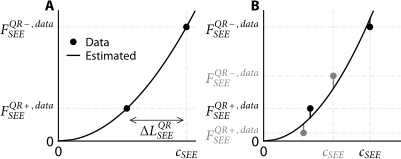
Figure 4: Graphical illustration of SEE stiffness parameter estimation. For each quick-release experiment, SEE force before (\(F_{SEE}^{QR-,data}\)) and after (\(F_{SEE}^{QR+,data}\)) the quick-release was obtained from the data, as well as the corresponding decrease in SEE length (\(\Delta L_{SEE}^{QR}\)). Since SEE length prior to the quick-release is typically unknown, a temporary parameter (\(c_{SEE}\)) was introduced for each experiment to represent the difference between SEE length before the quick-release and SEE slack length. A) A single quick-release experiment yields two unknowns: \(c_{SEE}\) and a parameter that scales SEE stiffness (\(k_{SEE}\)). B) Running multiple quick-release experiments yields n+1 unknowns: n values of \(c_{SEE}\) (one for each experiment) and the parameter scaling SEE stiffness. Here, two quick-release experiments are illustrated (one indicated with black dots, the other with grey dots), while the estimated SEE force-length relationship is depicted with the black line.

Figure 5

Code
# %% Imports etc.
import os, sys, pickle
import numpy as np
import matplotlib.pyplot as plt
plt.close('all')

# Paths
cwd = os.getcwd()
baseDir = os.path.join(cwd,'..')
dataDir = os.path.join(baseDir,'data')
funcDir = os.path.join(baseDir,'analysis','functions')
sys.path.append(funcDir)

# Custom imports
import cust_fig, hillmodel, mp_estimator

# %% Load muscle parameters
mus = 'GMs1'
parFile = os.path.join(dataDir,mus,'parameters',mus+'_OR.pkl')
muspar = pickle.load(open(parFile, 'rb'))

fmax = muspar['fmax']
vmax = muspar['b']/muspar['a']*muspar['fmax']

# %% Figure setup
cust_fig.style(plt, fontname='MinionPro', fontsize=11, grid=True)

fig = plt.figure(figsize=((15.92/3)/2.54+51/600, (15.92/3-0.07)/2.54), constrained_layout=True) # 3:2 ratio
gs = fig.add_gridspec(1,1)
axs = np.array([[fig.add_subplot(gs[i, j]) for j in range(gs.ncols)] for i in range(gs.nrows)])

# Plot 'data'
ax = axs[0,0]
fcerel = np.linspace(0,1,10000)
q = np.ones_like(fcerel)
lcerel = np.ones_like(fcerel)
fce = fcerel*muspar['fmax']
vce,vcerel = hillmodel.Fce2Vce(fce,q,lcerel,muspar)[0:2]
vcenorm = vce/vmax

# Plot data points
vcenormData = -np.array([0.8, 0.38, 0.11, 0.09])
fcerelData = np.array([0.09, 0.12, 0.37, 0.8])
lcerelData = np.array([1,1,1,1])
qData = hillmodel.ActState(1,lcerelData,muspar)[0]  # [ ] active state
vceModel, fceModel = mp_estimator.helpers.findModelFV(vcenormData*vmax,fcerelData*fmax,lcerelData,qData,muspar)
fcerelModel = fceModel/fmax
vcenormModel = vceModel/vmax

for vd,fd,vm,fm in zip(vcenormData,fcerelData,vcenormModel,fcerelModel):   
    ax.plot(vd,fd,'.',markersize=6,color=[0.75,0.75,0.75])
    ax.plot([vd, vm],[fd, fm],color=[0.75,0.75,0.75],linestyle='--')

vcenormData,fcerelData,lcerelData,fisomrelData,qData = [-0.43, 0.55, 1, 1, 1]
vceModel, fceModel = mp_estimator.helpers.findModelFV(np.array([vcenormData])*vmax,np.array([fcerelData])*fmax,np.array([lcerelData]),np.array([qData]),muspar)
fcerelModel = fceModel[0]/fmax
vcenormModel = vceModel[0]/vmax
p1,*_ = ax.plot(vcenormData,fcerelData,'.',markersize=6,color='k')
ax.plot([vcenormData, vcenormModel],[fcerelData, fcerelModel],linestyle='--',color='k')

# Right angle mark
idx = np.argwhere(np.diff(np.sign(vcenormModel - vcenorm))).flatten()+1
dvdf = np.gradient(fcerel,vcenorm)[idx]
x = np.linspace(vcenorm[idx]-0.125,vcenorm[idx]+0.125,100)
y = dvdf*x
ax.plot(x,y+fcerel[idx]-dvdf*vcenorm[idx],color=[0.5,0.5,0.5],linestyle='-')

a,b = np.polyfit([vcenormData, vcenormModel],[fcerelData, fcerelModel],1)
x = vcenorm
y = x*a+b-0.074

idx = np.argwhere(np.diff(np.sign(fcerel - y))).flatten()
x2 = np.linspace(vcenorm[idx]-0.0507,vcenorm[idx],10000)
y2 = x2*a+b-0.074
ax.plot(x2,y2,color=[0.6,0.6,0.6],linestyle='-')

x3 = x
b3 = x2[0]*a+b-0.074 - (x2[0]*dvdf)
y3 = dvdf*(x3)+b3

idx = np.argwhere(np.diff(np.sign(x*a+b - y3))).flatten()
x4 = np.linspace(x2[0],vcenorm[idx],10000)
y4 = dvdf*(x4)+b3
ax.plot(x4,y4,color=[0.5,0.5,0.5],linestyle='-')

# Check: L1 & L2 should be same length!
L1 = np.sqrt((x2[0]-x2[-1])**2 + (y2[0]-y2[-1])**2)
L2 = np.sqrt((x4[0]-x4[-1])**2 + (y4[0]-y4[-1])**2)

# Plot fce(vce)
l1,*_ = ax.plot(vcenorm,fcerel,'k')

#%% Labels, legend etc.
ax.legend(handles=[p1, l1],  # Only include 'Estimated' and 'Data' in this order
    labels = ['Data', 'Estimated'],
    loc='upper left',
    bbox_to_anchor=(0.02, 1.04),  # shift left (into space between axes) and center vertically
    bbox_transform=ax.transAxes,
    handlelength=1.0,
    handletextpad=0.5,
    labelspacing=0.2,

    alignment='left'
)

# Labels
ax.set_xlim(-1,0)
ax.set_xticks([vcenormData])
ax.set_xticklabels([r'$v_{CE}^{data}$'])
ax.set_ylim(0,1.07)
ax.set_yticks([fcerelData])
ax.set_yticklabels([r'$F_{CE}^{data}$'])

# %% Save and display
plt.show()
fig.savefig('m_fv.svg', bbox_inches="tight", pad_inches=0)
fig.savefig('m_fv.pdf', bbox_inches="tight", pad_inches=0)

# %% Checks
if check_size:
    cust_fig.report_axes_size(fig,axs.flatten())
    cust_fig.report_fig_size("m_fv.svg")
    cust_fig.report_fig_size("m_fv.pdf")  
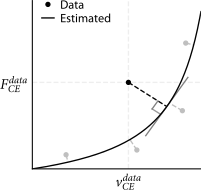
Figure 5: Graphical illustration of the CE force-velocity parameter estimation using total least squares. For each step-ramp experiment, CE force and CE velocity was obtained during the interval in which SEE force changed the least. The nearest point on the CE force-velocity relationship was identified based on two criteria: it should satisfy ?@eq-fvcon, and the line from the datapoint to the CE force-velocity relationship should be perpendicular the CE force-velocity relationship. This was done for all step-ramp experiments (other datapoints are depicted in grey), while the estimated CE force-velocity relationshp is depicted with the black line.

Results

Figure 6

Code
# %% Imports
import os, sys, glob
import numpy as np
import pandas as pd
import matplotlib.pyplot as plt
import matplotlib.patches as patches
from matplotlib.path import Path
plt.close('all')

# Paths
cwd = os.getcwd()
baseDir = os.path.join(cwd,'..')
dataDir = os.path.join(baseDir,'data')
funcDir = os.path.join(baseDir,'analysis','functions')
sys.path.append(funcDir)

# Custom imports
import cust_fig, helpers

# %% Figure setup
cust_fig.style(plt, fontname='MinionPro', fontsize=11, grid=True)

#fig = plt.figure(figsize=(15.92/2.54+64/600, (15.92/3+0.57)/2.54), constrained_layout=True)
fig = plt.figure(figsize=(15.92/2.54+64/600, (15.92/3+0.57)/2.54), constrained_layout=True)
gs = fig.add_gridspec(2, 3, height_ratios=[1, 36])
axs = np.array([[fig.add_subplot(gs[i, j]) for j in range(gs.ncols)] for i in range(gs.nrows)])
ax_inset = fig.add_axes([0.15, 0.2, 0.15, 0.2])

colorSet = plt.rcParams['axes.prop_cycle'].by_key()['color']
colorSet[3] = colorSet[0]
colorSet[0] = '#000000'
colors = colorSet
linestyles = ['-', '--', '-.', ':']

# %% Datafile info
mus = 'GMs1'
iFile = [5,3,5]
protocol = ['QR','SR','ISOM']

# %% Plot STIM
for iExp,exp in enumerate(['QR','SR','ISOM']):
    dataDirExp = os.path.join(dataDir,mus,'dataExp',exp,'')
    files = sorted(glob.glob(dataDirExp+mus+r'*.csv'))
    iSel = iFile[iExp]
    filepath = files[iSel]
    data = pd.read_csv(filepath).T.to_numpy()
    time, lmtc, stim, fsee = data[0:4]
    
    _,tStimOn,tStimOff = helpers.get_stim(time,stim)
    
    verts = [
       (tStimOn[0], 0.99),  # left, bottom
       (tStimOn[0], 1.01),  # left, top
       (tStimOff[0], 1.01),  # right, top
       (tStimOff[0], 0.99),  # right, bottom
    ]

    codes = [
        Path.MOVETO,
        Path.LINETO,
        Path.LINETO,
        Path.LINETO,
    ]

    path = Path(verts, codes)
    patch = patches.PathPatch(path, facecolor='k', lw=0)
    
    ax = axs[0, iExp]  # top row for STIM
    ax.add_patch(patch)
    ax.set_axis_off()
    ax.autoscale(enable=True, axis='y', tight=True)

# %% Plot SEE Force
lineSet = []
for iExp,exp in enumerate(['QR','SR','ISOM']):
    iSel = iFile[iExp] # fileNo. to be plotted.
    for iPar,vPar in enumerate(['OR','TM','IM','MC']):
        ax = axs[1, iExp]  # top row for STIM
        if vPar != 'MC':
            if vPar == 'OR':
                dataDirExp = os.path.join(dataDir,mus,'dataExp',exp,'')
            else:
                dataDirExp = os.path.join(dataDir,mus,'simsExp',vPar,exp,'') 
            files = sorted(glob.glob(dataDirExp+mus+r'*.csv'))
            filepath = files[iSel]
            data = pd.read_csv(filepath).T.to_numpy()
            time, lmtc, stim, fsee = data[0:4]
            
            l, = ax.plot(time,fsee,color=colors[iPar],linestyle=linestyles[iPar])
            lineSet.append(l)
            if exp == 'QR':
                ax_inset.plot(time,fsee,color=colors[iPar],linestyle=linestyles[iPar])
        elif vPar == 'MC':
            if exp == 'QR':
                n = 1000
            elif exp == 'SR':
                n = 1000
            elif exp == 'ISOM':
                n = 500
            
            fseeStack = np.empty((0,n))
            for iMC in range(1,51):
                dataDirExp = os.path.join(dataDir,mus,'simsMC',exp,f'{iMC:02d}','')

                subfldr = vPar+'{:02d}'.format(iMC)
                fileName = mus+'_'+exp+f'{iSel:02d}'+'_'+subfldr+'.csv'
                data = pd.read_csv(dataDirExp+fileName).T.to_numpy()
                
                time, lmtc, stim, fsee = data[0:4]
                fseeStack = np.vstack((fseeStack,fsee[0:n]))
            m = np.mean(fseeStack,0)
            s = np.std(fseeStack,0)
            
            ci = 1.96 * s/np.sqrt(50)
            mi = m-ci
            mx = m+ci
            # axs[iAx].fill_between(time, (m-ci), (m+ci), color='b', alpha=.1)
            l, = ax.plot(time[0:n],m,color=colors[iPar],linestyle=linestyles[iPar])
            ax.fill_between(time[0:n], (mi), (mx), color=colors[iPar], alpha=.25)
            lineSet.append(l)
            
            if exp == 'QR':
                ax_inset.fill_between(time[0:n], (mi), (mx), color=colors[iPar], alpha=.25)
                ax_inset.plot(time[0:n],m,color=colors[iPar],linestyle=linestyles[iPar])
                
# %% Labels & Titles etc.
lineSet = lineSet[0:4]
legend_labels = ['Actual', 'TM', 'IM', 'MC']
for line, label in zip(lineSet, legend_labels):
    line.set_label(label)

fig.legend(handles=lineSet,
           title=r"Parameter set",
           title_fontproperties={'weight':'bold'},
           loc='outside right',
           # bbox_to_anchor=(1, .5),
           frameon=False,
           handlelength=1.45,
           handletextpad=0.5,
           labelspacing=0.2,
           alignment='left'
           )

axs[0,0].set_title('QR')
axs[0,1].set_title('SR')
axs[0,2].set_title('ISOM')

axs[1,0].set_xlabel('Time [s]')
axs[1,1].set_xlabel('Time [s]')
axs[1,2].set_xlabel('Time [s]')
axs[1,0].set_ylabel('$F_{SEE}$'+' [N]')

axs[0,0].set_xlim(0.1,0.5)
axs[1,0].set_xlim(0.1,0.5)
axs[1,0].set_xticks([0.1,0.3,0.5])
axs[1,0].set_xticklabels(['0.0','0.2','0.4'])
axs[1,0].set_xticks([0.2,0.4], minor=True)
axs[1,0].set_ylim(0,13.5)
axs[1,0].set_yticks([0,4,8,12])
axs[1,0].set_yticks([2,6,10], minor=True)

axs[0,1].set_xlim(0.1,0.5)
axs[1,1].set_xlim(0.1,0.5)
axs[1,1].set_xticks([0.1,0.3,0.5])
axs[1,1].set_xticklabels(['0.0','0.2','0.4'])
axs[1,1].set_xticks([0.2,0.4], minor=True)
axs[1,1].set_ylim(0,13.5)
axs[1,1].set_yticks([0,4,8,12])
axs[1,1].set_yticks([2,6,10], minor=True)

axs[0,2].set_xlim(0.1,0.265)
axs[1,2].set_xlim(0.1,0.265)

axs[1,2].set_xticks([0.1,0.2])
axs[1,2].set_xticklabels(['0.0','0.1'])
axs[1,2].set_xticks([0.15,0.25], minor=True)
axs[1,2].set_ylim(0,13.5)
axs[1,2].set_yticks([0,4,8,12])
axs[1,2].set_yticks([2,6,10], minor=True)

fig.canvas.draw()
ax_inset.set_xlim(0.295,0.345)
ax_inset.set_ylim(9.5,12.7)
ax_inset.set_xticklabels([])
ax_inset.set_yticklabels([])
ax_inset.grid(False)
pos = [axs[1,0].get_position().x0+0.08, axs[1,0].get_position().y0+0.05, axs[1,0].get_position().width-0.16, axs[1,0].get_position().height-0.3]
ax_inset.set_position(pos)

cust_fig.add_labels(fig,axs[1,:],['A','B','C'])

# %% Save and display 
plt.show()     
fig.savefig('r_protocols.svg', bbox_inches="tight", pad_inches=0)
fig.savefig('r_protocols.pdf', bbox_inches="tight", pad_inches=0)

# %% Checks
if check_size:
    cust_fig.report_axes_size(fig,axs.flatten()) 
    cust_fig.report_fig_size("r_protocols.svg") 
    cust_fig.report_fig_size("r_protocols.pdf") 
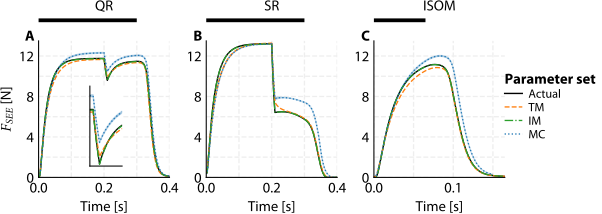
Figure 6: Representative example of SEE force over time during a quick-release (A), step-ramp (B) and isometric experiment (C). The inset in (A) depicts the SEE force over time around the quick-release. The SEE force over time is depicted for four sets of parameter values: 1) the actual values (i.e., literature-obtained; black solid line), those obtained with the traditional method (TM; orange dashed line), those obtained with the improved method (IM; green dashed-dotted line) and those resulting from the Monte Carlo Simulations (MC; blue dotted line, with shaded 95% confidence interval).

Figure 7

Code
# %% Imports
import os, sys, pickle
import numpy as np
import matplotlib.pyplot as plt
plt.close('all')

# Paths
cwd = os.getcwd()
baseDir = os.path.join(cwd,'..')
dataDir = os.path.join(baseDir,'data')
funcDir = os.path.join(baseDir,'analysis','functions')
sys.path.append(funcDir)

# Custom imports
import cust_fig, hillmodel

# %% Load muscle parameters
mus = 'GMe1'
parFile = os.path.join(dataDir,mus,'parameters',mus+'_IM.pkl')
muspar, dataQRout, dataSRout, dataACTout = pickle.load(open(parFile, 'rb'))

# %% Figure setup
cust_fig.style(plt, fontname='MinionPro', fontsize=11, grid=True)

fig = plt.figure(figsize=((15.92/2)/2.54+50/600, (15.92/3+0.43)/2.54), constrained_layout=True) # 3:1 ratio
gs = fig.add_gridspec(2,2)
axs = np.array([[fig.add_subplot(gs[i, j]) for j in range(gs.ncols)] for i in range(gs.nrows)])

colorSet = plt.rcParams['axes.prop_cycle'].by_key()['color']
colorSet[3] = colorSet[0]
colorSet[0] = '#000000'
colors = colorSet

# %% Panel A: Fsee(Lsee)
ax = axs[0,0]
lseeQRpre = dataQRout['lseeQRpre']
lseeQRpst = dataQRout['lseeQRpst']
fseeQRpre = dataQRout['fseeQRpre']
fseeQRpst = dataQRout['fseeQRpst']
lpeeQR = dataQRout['lpeeQR']
fpeeQR = dataQRout['fpeeQR']
lmtcQRpre = dataQRout['lmtcQRpre']

lsee = np.linspace(muspar['lsee0'],muspar['lsee0']+(muspar['fmax']/muspar['ksee'])**0.5,100)
fsee = hillmodel.LEE2Force(lsee,0,muspar)[0]
ax.plot(lsee,fsee,'k',)
ax.plot(lseeQRpre,fseeQRpre,'.',color=colorSet[1])
ax.plot(lseeQRpst,fseeQRpst,'.',color=colorSet[1])

ax.set_xlabel('$L_{SEE}$'+' [mm]')
ax.set_ylabel('$F_{SEE}$'+' [N]')
ax.set_xlim(0.029,0.0335)
ax.set_xticks([0.029,0.030,0.031,0.032,0.033])
ax.set_xticklabels(['29','','31','','33'])
ax.set_ylim(0,17.5)
ax.set_yticks([0,3,6,9,12,15])
ax.set_yticklabels(['0','','6','','12',''])

# %% Panel B: Fpee(Lpee)
ax = axs[0,1]
lpee = np.linspace(muspar['lpee0'],muspar['lpee0']+(muspar['fmax']/muspar['kpee'])**0.5,100)
fpee = hillmodel.LEE2Force(0,lpee,muspar)[1]
ax.plot(lpee,fpee,'k') 
ax.plot(lpeeQR,fpeeQR,'.',color=colorSet[1])

ax.set_xlabel('$L_{PEE}$'+' [mm]')
ax.set_ylabel('$F_{PEE}$'+' [N]')
ax.set_xlim(0.0105,0.0195)
ax.set_xticks([0.011,0.013,0.015,0.017,0.019])
ax.set_xticklabels(['11','','15','','19'])
ax.set_ylim(0,0.55)
ax.set_yticks([0,0.1,0.2,0.3,0.4,0.5])
ax.set_yticklabels(['0.0','','0.2','','0.4',''])

# Panel C: Fsee(Lmtc)
ax = axs[1,0]
lmtc = np.linspace((1-muspar['w'])*muspar['lce_opt']+muspar['lsee0'],(1+muspar['w'])*muspar['lce_opt']+muspar['lsee0'],100)
fsee = hillmodel.ForceEQ(lmtc,1,muspar)[0]
ax.plot(lmtc,fsee,'k') 
ax.plot(lmtcQRpre,fseeQRpre,'.',color=colorSet[1])

ax.set_xlabel('$L_{MTC}$'+' [mm]')
ax.set_ylabel('$F_{SEE}$'+' [N]')
ax.set_xlim(0.0335,0.0485)
ax.set_xticks([0.035,0.038,0.041,0.044,0.047])
ax.set_xticklabels(['35','','41','','47'])
ax.set_ylim(0,17.5)
ax.set_yticks([0,3,6,9,12,15])
ax.set_yticklabels(['0','','6','','12',''])

# Panel D: fce(vce)
ax = axs[1,1]
vceSR = dataSRout['vceSR']
fceSR = dataSRout['fceSR']
lcerelSR = dataSRout['lcerelSR']
fce = np.linspace(0,1,100)*muspar['fmax']
lcerelSR_mean = np.ones_like(fce)*lcerelSR.mean()
q = hillmodel.ActState(1,lcerelSR_mean,muspar)[0]
vce = hillmodel.Fce2Vce(fce,q,lcerelSR_mean,muspar)[0]
ax.plot(vce,fce,'k') 
ax.plot(vceSR,fceSR,'.',color=colorSet[1])

ax.set_xlabel('$V_{CE}$'+' [mm/s]')
ax.set_ylabel('$F_{CE}$'+' [N]')
ax.set_xlim(-0.15,0)
ax.set_xticks([-0.125,-0.10,-0.075,-0.05,-0.025,0])
ax.set_xticklabels(['','-100','','50','','0'])
ax.set_ylim(0,17.5)
ax.set_yticks([0,3,6,9,12,15])
ax.set_yticklabels(['0','','6','','12',''])

# %% Labels & Titles
cust_fig.add_labels(fig,axs.flatten(),['A','B','C','D'])

# Save and display 
plt.show()
fig.savefig('r_insitu_fit.svg', bbox_inches="tight", pad_inches=0)
fig.savefig('r_insitu_fit.pdf', bbox_inches="tight", pad_inches=0)

# %% Checks
if check_size:
    cust_fig.report_axes_size(fig,axs.flatten())
    cust_fig.report_fig_size("r_insitu_fit.svg") 
    cust_fig.report_fig_size("r_insitu_fit.pdf") 
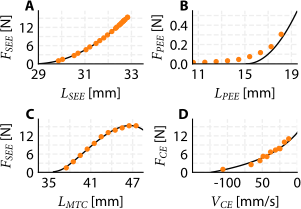
Figure 7: Representative example of experimental in situ data of rat 1 for the SEE force-length relationship (A), PEE force-length relationship (B), MTC force-length relationship (C) and the CE force-velocity relationship (D).** The orange dots depicts the experimental in situ data and the solid black line depicts the model fit.

Figure 8

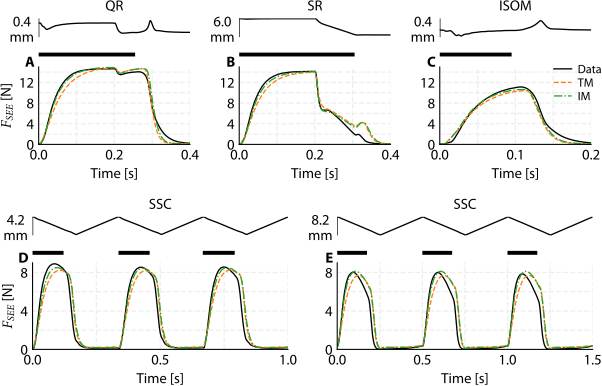
Figure 8: Representative example of experimental in situ data and simulation results of rat 1 for SEE force over time during a quick-release experiment (A), step-ramp experiment (B), isometric experiment (C) and two stretch-shortening cycles (D & E). The simulation results were obtained by re-simulating the experimental protocol with the MTC length and CE stimulation from the experimental data as input and by using either the parameter set obtained with the traditional method (TM; orange dashed line) or the improved method (IM; green dash-dotted line). For each panel, the top plot represents MTC length over time, with the bar indicating its range in mm. CE stimulation is maximal during the periods indicated by the black bars and is ‘off’ elsewhere.

Supplementary material

Figure S1

Code
# %% Imports
import glob, os, sys, pickle
import numpy as np
import pandas as pd
from pathlib import Path
import matplotlib.pyplot as plt
from scipy import integrate
plt.close('all')

# Set directories
cwd = Path.cwd()
baseDir = cwd.parent
dataDir = baseDir / 'data'
funcDir = baseDir / 'analysis' / 'functions'
sys.path.append(str(funcDir))

# Custom imports
import cust_fig, hillmodel, isotonic

#%%
cust_fig.style(plt, fontname='MinionPro', fontsize=11, grid=True)

fig = plt.figure(figsize=(15.92/2.54+51/600, (15.92/2-0.54)/2.54), constrained_layout=True) # 2:3 ratio (1254px x 1880px)
gs = fig.add_gridspec(3,2)
axs = np.array([[fig.add_subplot(gs[i, j]) for j in range(gs.ncols)] for i in range(gs.nrows)])

colorSet = plt.rcParams['axes.prop_cycle'].by_key()['color']
colorSet[3] = colorSet[0]
colorSet[0] = '#000000'

#%% Load muscle parameter values
mus = 'GMs1'
parFile = os.path.join(dataDir,mus,'parameters',mus+'_OR.pkl')
muspar = pickle.load(open(parFile, 'rb'))

#%% First plot of servomotor
exp = 'SR'
vPar = 'OR'
dataDirExp = os.path.join(dataDir,mus,'dataExp',exp,'')

files = sorted(glob.glob(dataDirExp+r'*')) 
filepath = files[3]
data = pd.read_csv(filepath).T.to_numpy()
time, lmtc, stim, fsee = data[0:4,200:]
time = time-time[0]
vmtc = np.gradient(lmtc,time)            

axs[0,0].plot(time,lmtc,color=colorSet[0])
axs[1,0].plot(time,fsee,color=colorSet[0])
axs[1,0].plot(time[428],fsee[428],'.',color=colorSet[1])
axs[2,0].plot(time,vmtc,color=colorSet[0])
axs[2,0].plot(time[428],vmtc[428],'.',color=colorSet[1])

#%% Then of lever system
lmtc0 = lmtc[0] # start with same length at t=0

inputs = {}
inputs['tIso'] = 0.2
inputs['lmtc0'] = lmtc0
inputs['fseeDrop'] = 6.4
inputs['shorteningDistance'] = -np.nan # never stop isotnic mode..

#
tspan   = [0, 0.4]
gamma0  = muspar['gamma_0']
lcerel0 = hillmodel.ForceEQ(lmtc0,gamma0,muspar)[1]
state0  = [gamma0, lcerel0, 0]
fun     = lambda t, x: isotonic.SimuIso(t,x,inputs,muspar)[0]
event   = lambda t, x: isotonic.endSimu(t,x,inputs,muspar)
event.terminal = False
sol     = integrate.solve_ivp(fun,tspan,state0,method='Radau',rtol=1e-6,dense_output=True,events=event)

# Post-proceess
time = np.arange(*[0, sol.t[-1]], 1e-3)
state = sol.sol(time)
statedot, y = isotonic.SimuIso(time,state,inputs,muspar)

# Unravel
gamma = state[0]
lcerel = state[1]
H = state[2]

gammad = statedot[0]
vcerel = statedot[1]
Hdot = statedot[2]

lmtc = y[0]
stim = y[1]
fsee = y[2]
vmtc = np.gradient(lmtc,time)

axs[0,1].plot(time,fsee,color=colorSet[0])
axs[0,1].plot(time[214],fsee[214],'.',color=colorSet[1])
axs[1,1].plot(time,lmtc,color=colorSet[0])
axs[2,1].plot(time,vmtc,color=colorSet[0])
axs[2,1].plot(time[214],vmtc[214],'.',color=colorSet[1])

#%% Axis etc.
for ax in axs.flatten():
    ax.set_xlim(0,0.4)
    ax.set_xticks([])
    ax.set_yticks([])

for ax in [axs[0,0], axs[2,0]]: # lmtc
    ax.set_ylim(37e-3,44e-3)
for ax in [axs[0,1], axs[1,1]]: # fsee
    ax.set_ylim(0,14)
for ax in [axs[2,0], axs[2,1]]: # vmtc
    ax.set_ylim(-0.08,1e-2) 

axs[0,0].set_title('' + '\n Impose')
axs[0,0].set_ylabel('$L_{MTC}$')
axs[0,1].set_title('' + '\n Impose')
axs[0,1].set_ylabel('$F_{SEE}$')
axs[1,0].set_title('Measure')
axs[1,0].set_ylabel('$F_{SEE}$')
axs[1,1].set_title('Measure')
axs[1,1].set_ylabel('$L_{MTC}$')
axs[2,0].set_title('Compute')
axs[2,0].set_ylabel('$v_{MTC}$')
axs[2,1].set_title('Compute')
axs[2,1].set_ylabel('$v_{MTC}$')

axs[2,0].set_xlabel('Time')
axs[2,1].set_xlabel('Time')

# axs[0,0].set_title('Servomotor: length-controlled' + '\n Impose', fontweight='bold')
# axs[0,1].set_title('Lever: force-controlled' + '\n Impose', fontweight='bold')
fig.text(0.27, 0.95, 'Servomotor: length-controlled', ha='center', fontweight='bold')
fig.text(0.77, 0.95, 'Lever: force-controlled', ha='center', fontweight='bold')

# %% Save
fig.align_labels() 
plt.show()
fig.savefig('s_servo_vs_lever.svg', bbox_inches="tight", pad_inches=0)
fig.savefig('s_servo_vs_lever.pdf', bbox_inches="tight", pad_inches=0)

# %% Checks
if check_size == True or check_size == 'True':
    cust_fig.report_axes_size(fig,axs.flatten())
    cust_fig.report_fig_size("s_servo_vs_lever.svg") 
    cust_fig.report_fig_size("s_servo_vs_lever.pdf") 
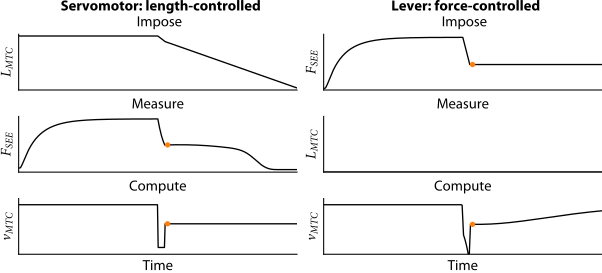
Figure S1: Comparison between a length-controlled step-ramp experiment and a force-controlled quick-release experiment. In length-controlled step-ramp experiment (left), MTC length over time is imposed using a servomotor, while SEE force is measured. MTC velocity is computed at the time instance at which SEE force is near constant. In the force-controlled quick-release experiment (right), SEE force over time is imposed via a lever, while MTC length is measured. MTC velocity is computed at the time instance where MTC velocity is maximal after the change in SEE force. Both methods yield one datapoint (depicted with the orange dot) of the force-velocity relationship.

Figure S2

Code
import sys
import matplotlib.pyplot as plt
import schemdraw
from pathlib import Path
from schemdraw import flow
plt.close('all')

# Set directories
cwd = Path.cwd()
baseDir = cwd.parent
dataDir = baseDir / 'data'
funcDir = baseDir / 'analysis' / 'functions'
sys.path.append(str(funcDir))

# Custom import
import cust_fig

#%%
cust_fig.style(plt, fontname='MinionPro', fontsize=11, grid=True)

width = 6
height = 1.2

# IMPORTANT: no context manager
d = schemdraw.Drawing()
d.config(fontsize=11)

# Box 1: Start block
start = flow.Start(w=width, h=height).label(
    'Estimate parameter values: \n no correction for CE shortening')
d += start
d += flow.Arrow().down(d.unit/5)

# Box 2: P_old assignment
pold = flow.Box(w=width, h=height).label(
    'Assign: \n estimated parameter values to $P_{old}$.')
d += pold
d += flow.Arrow().down(d.unit/5)

# --- Box 3: Correction block
correction1 = flow.Box(w=width, h=height).label(
    'Estimate parameter values: \n correction for CE shortening')
d += correction1
d += flow.Arrow().down(d.unit/5)

# Box 4: P_new assignment
pnew1 = flow.Box(w=width, h=height).label(
    'Assign: \n estimated parameter values to $P_{new}$.')
d += pnew1
d += flow.Arrow().down(d.unit/5)

# Box: Decision
decision = flow.Decision(
    w=width, h=width/1.5, E='YES', S='NO'
).label(
    'Is the difference \n between $P_{old}$ and $P_{new}$ \n less than 0.1% for\n all parameter values?'
)
d += decision

# Box 5: NO case, update Pold
d += flow.Arrow().down(d.unit/5).at(decision.S)
pold_update = flow.Box(w=width, h=height).label(
    "Assign: \n $0.7 \\cdot P_{old} + 0.3 \\cdot P_{new}$ to $P_{old}$.")
d += pold_update
d += flow.Arrow().down(d.unit/5)

# Box 6: NO case, estimate again
correction2 = flow.Box(w=width, h=height).label(
    'Estimate parameter values: \n correction for CE shortening')
d += correction2
d += flow.Arrow().down(d.unit/5)

# Box 7: NO case, update Pnew
pnew2 = flow.Box(w=width, h=height).label(
    'Assign: \n estimated parameter values to $P_{new}$.')
d += pnew2

# Loop arrows from Pnew to decision
d += flow.Line().down(d.unit/5)
d += flow.Line().left().tox(width/2 + d.unit/2.5)
d += flow.Line().up().toy(decision.E)
d += flow.Arrow().right().tox(decision.W)

# Box ..: YES case path
d += flow.Arrow().right(d.unit/2.5).at(decision.E)
pfinal = flow.Box(w=width, h=height).label(
    'Final estimated parameter \n values are $P_{new}$.')
d += pfinal.at(decision.E, dx=1.2)

# %% Draw & save
d.draw()
d.save('s_flowchart.svg')
d.save('s_flowchart.pdf')

# %% Checks
if check_size == True or check_size == 'True':
    cust_fig.report_fig_size("s_flowchart.svg") 
    cust_fig.report_fig_size("s_flowchart.pdf")

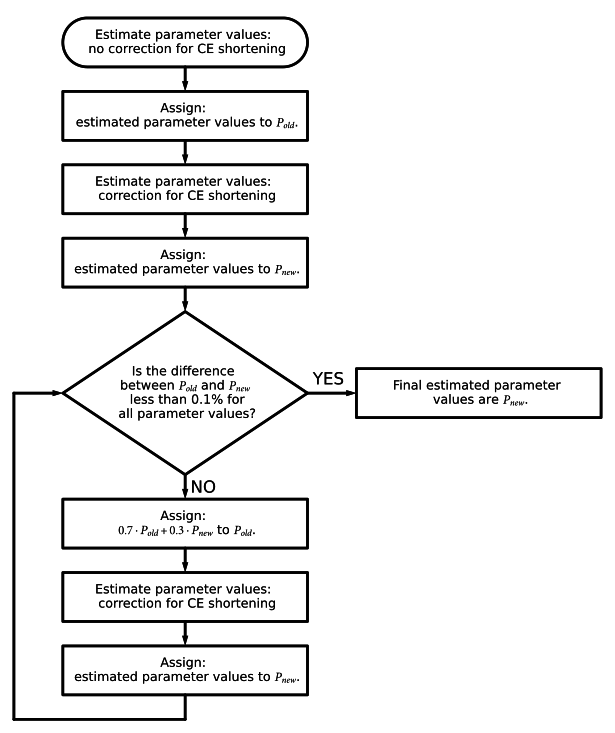
d
Figure S2: Flowchart of the improved method. Using the improved method, parameter values were estimated until the change in all parameter values was less than 0.1%.

Figure S3

Code
# %% Imports
import os, pickle, sys
import numpy as np
from pathlib import Path
import matplotlib.pyplot as plt
plt.close('all')

# Set directories
cwd = Path.cwd()
baseDir = cwd.parent
dataDir = baseDir / 'data'
funcDir = baseDir / 'analysis' / 'functions'
sys.path.append(str(funcDir))

# Custom import
import cust_fig, stats

plt.close('all')

#%% Make figure
cust_fig.style(plt, fontname='MinionPro', fontsize=11, grid=True)

fig = plt.figure(figsize=(15.92/2.54/2+51/600, (15.92/2-0.47)/2.54), constrained_layout=True) # 2:3 ratio (1254px x 1880px)
gs = fig.add_gridspec(1,1)
axs = np.array([fig.add_subplot(gs[i]) for i in range(0,gs.ncols*gs.nrows)])

#%% Extract parameters
mus = 'GMs1'
parDir = os.path.join(baseDir,'data','suppmat','')
orPar = pickle.load(open(os.path.join(dataDir,mus,'parameters',mus+'_OR.pkl'), 'rb'))

p_diff = []
for qr in ['QR01','QR04','QR07','QR10','QR15','QR20']:
    tmPar = pickle.load(open(parDir+mus+'_'+qr+'.pkl', 'rb'))[0]
    p_diff.append(stats.pdiff(tmPar['ksee'],orPar['ksee']))
    
#%% Plot
tStep = [int(x[2:]) for x in ['QR01','QR04','QR07','QR10','QR15','QR20']]
axs[0].plot(tStep,p_diff,'k.-')
axs[0].set_xlabel('Duration of quick-release [ms]')
axs[0].set_ylabel('SEE stiffness \n' +'underestimation [%]')

# %% Save
fig.align_labels() 
plt.show()
fig.savefig('s_servo_vs_lever.svg', bbox_inches="tight", pad_inches=0)
fig.savefig('s_servo_vs_lever.pdf', bbox_inches="tight", pad_inches=0)

# %% Checks
if check_size == True or check_size == 'True':
    cust_fig.report_axes_size(fig,axs)
    cust_fig.report_fig_size("s_ksee_qr_duration.svg") 
    cust_fig.report_fig_size("s_ksee_qr_duration.pdf") 
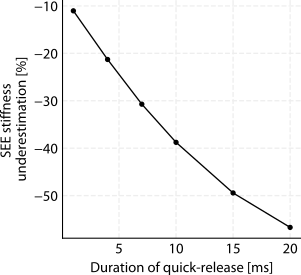
Figure S3: Relationship between quick-release duration and SEE stiffness understimation. When the duration of the quick-release increases, the underestimation of SEE stiffness increases.